At 9:36 AM, we boarded the Tohoku Shinkansen “Hayabusa No. 11” bound for Hakodate-Hokuto.
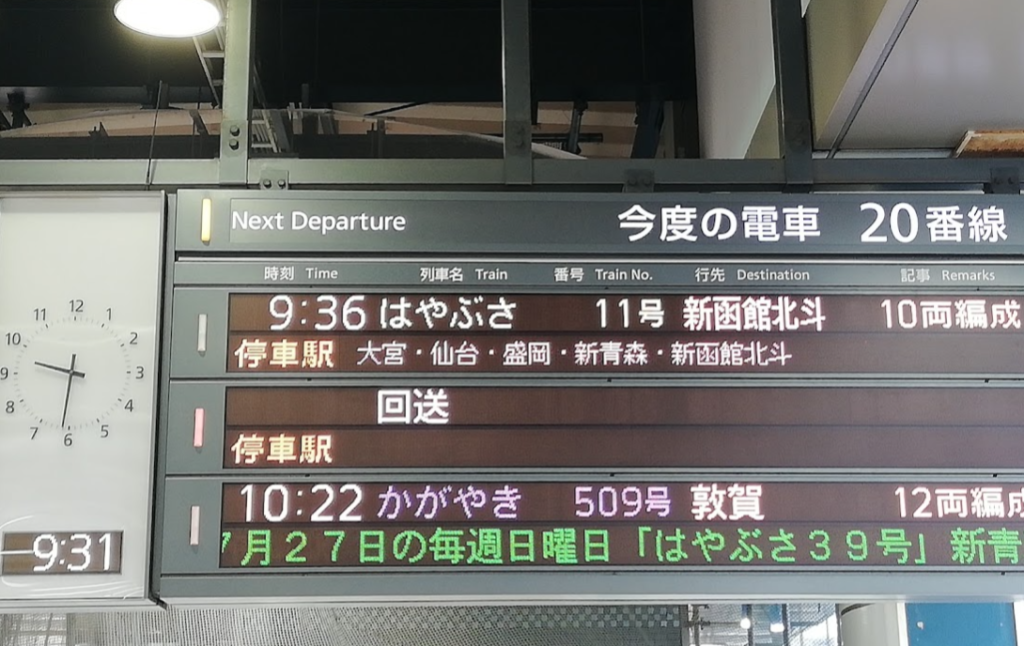
Tohoku Shinkansen/Hokkaido Shinkansen Route Map
Tokyo ── Ueno ── Omiya ── Sendai ── Morioka ── Shin-Aomori ── Shin-Hakodate-Hokuto
│ │ │ │ │ │ │
9:36 9:43 10:04 11:31 12:35 13:34 14:22
*Hayabusa No. 11 Timetable (Reference)
My husband only bought one bottle of canned coffee. I, on the other hand, found his lack of money almost refreshing.
As the scenery outside the window gradually became more typical of a northern region, my husband began to speak, “Moo-moo, did you know that Aomori apples are actually based on a variety introduced from America during the Meiji era?”
My husband’s trivia session began once again. “The Tsugaru domain encouraged Western-style agriculture. But serious cultivation didn’t begin until around 1875.”
My husband’s useless knowledge is typical, but it’s just right for passing the time during our journey. However, this might be the furthest we’ve traveled since Nagasaki.
Arrival at Shin-Aomori – The Mystery of the VIP Security
At 1:34 PM, we arrived at Shin-Aomori Station, and the sight of numerous police officers swarming the station was a stark contrast.
“Hey, what’s going on?” my husband asked a station attendant. The reply was, “A high-ranking government official is coming to give a speech.”
I thought to myself: To come all the way to Aomori and spend time listening to a politician speak is completely missing the point. Our purpose is gourmet food, not political discussion.
The Shin-Aomori station building was surprisingly modern, maintaining its dignity as the northern gateway. As I looked around the station, my husband suddenly became excited.
Husband:
“Moo moo, we’ve finally reached Aomori! We’ve come all the way to the northernmost point of Honshu!”
We transferred to the Hakodate Main Line and arrived at Aomori Station in about 5 minutes. It’s only one stop, but even this short section has a distinct Tsugaru atmosphere.
In the background is the Aoimori Railway.
Aomori Station is a relatively new station, having moved to its current location in 1986, but its predecessor was a historic station that opened in 1891. As the northernmost station on Honshu, it has welcomed countless travelers.
Husband:
“The Aomori-Hakodate Ferry used to depart from here. It connected Honshu and Hokkaido for 80 years until 1988.”
The husband murmured thoughtfully.
Aomori Station:
Although the ferry service was discontinued with the opening of the Aomori-Hakodate Tunnel, a monument commemorating its former existence still stands in front of Aomori Station.
Aomori Fish and Vegetable Center – The Baptism of the Donburi Serving
We headed straight to the “Aomori Fish and Vegetable Center Main Store,” which we had researched beforehand. It was about a 10-minute walk from the station, closer than we expected.
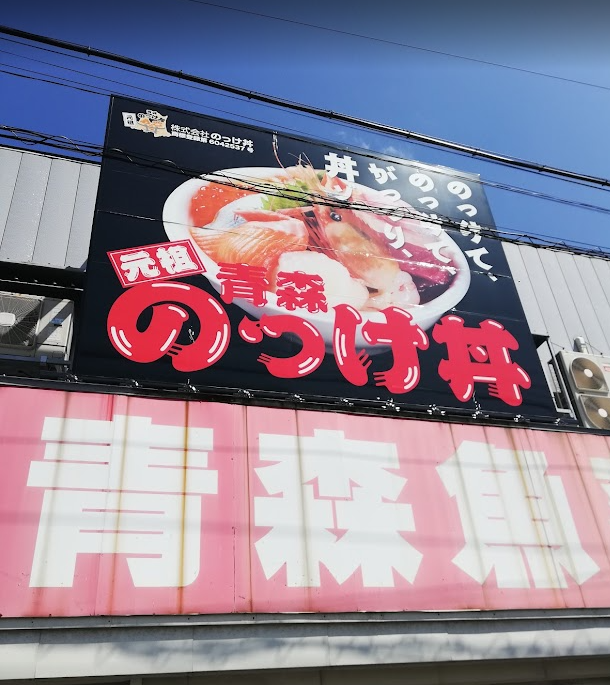
This market was established in the 1960s and has been loved by locals as Aomori’s kitchen. In particular, the “Nokke-don” system is very popular with tourists. It’s a unique style where you first purchase a meal ticket (worth about 2000 yen), then visit various shops in the market to choose your favorite seafood toppings, ultimately creating your own original seafood bowl.
“Hey, what do we do?” my husband asked, confused. I was equally bewildered.
“Welcome! Buy a meal ticket and go around to your favorite shops!” a cheerful shop assistant explained.
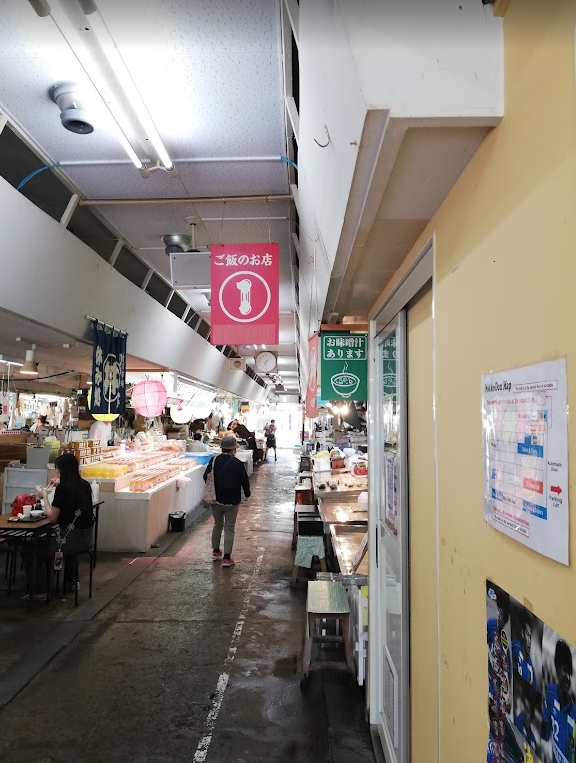
First, we purchased 2000 yen worth of meal tickets from the vending machine. This was a rather complicated system, and my husband chuckled, “What is this? It’s like a game.”
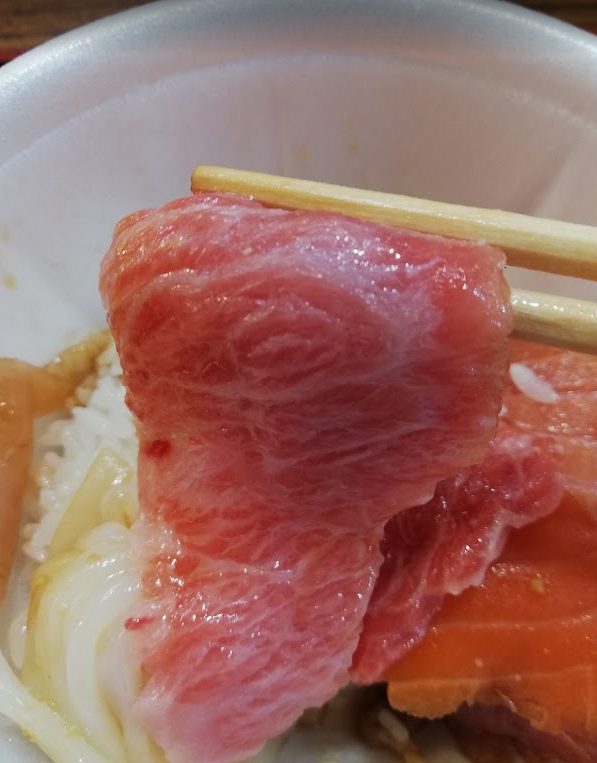
Our first stop was a tuna specialty shop. “Don’t you have any Ooma tuna?” my husband asked. “We have some bluefin tuna medium fatty cut today!” the reply came.
“Oh, this is exactly what I was looking for!”
Next, we went to a sea urchin specialty shop. Aomori sea urchins are said to be particularly sweet because they feed on Rishiri kelp. “Moo moo, speaking of sea urchin trivia, the type of kelp actually determines the taste,” the shop owner explained.
The shop owner joked, “Do cows eat it too?” I replied, “I’m a ruminant, so I’ll pass on seafood, moo,” which made him laugh heartily.
My husband selected salmon roe, salmon, and scallops in order. Finally, he added some bigfin reef squid, and it was complete.
The bowl arrived!
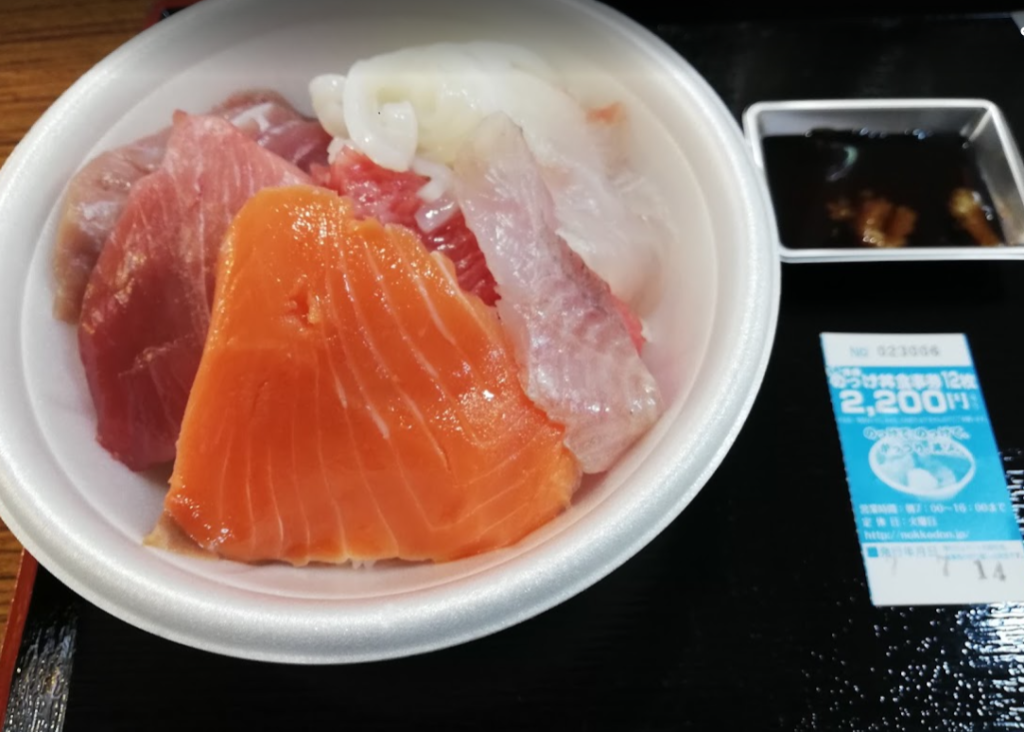
A bowl beautifully arranged with colorful seafood was placed in front of my husband. It was truly a jewel box of Aomori’s sea.
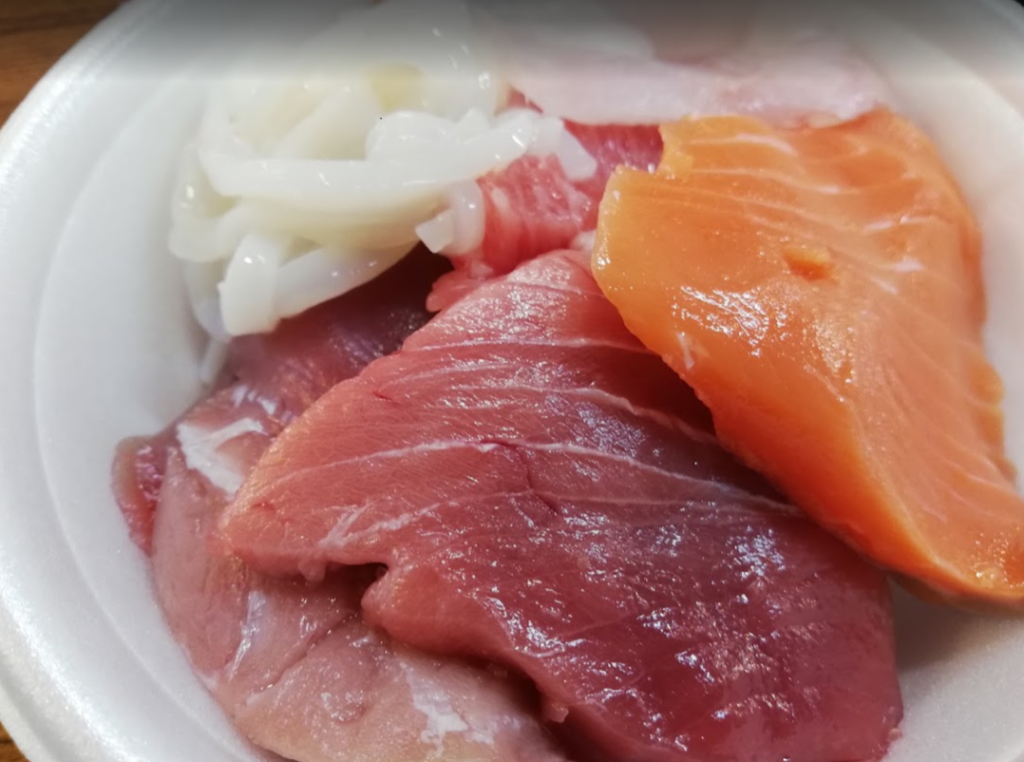
My husband took a bite and exclaimed excitedly, “Delicious! This is really good, moo moo!” The long-awaited Oma bluefin tuna bowl
A unique ticket system
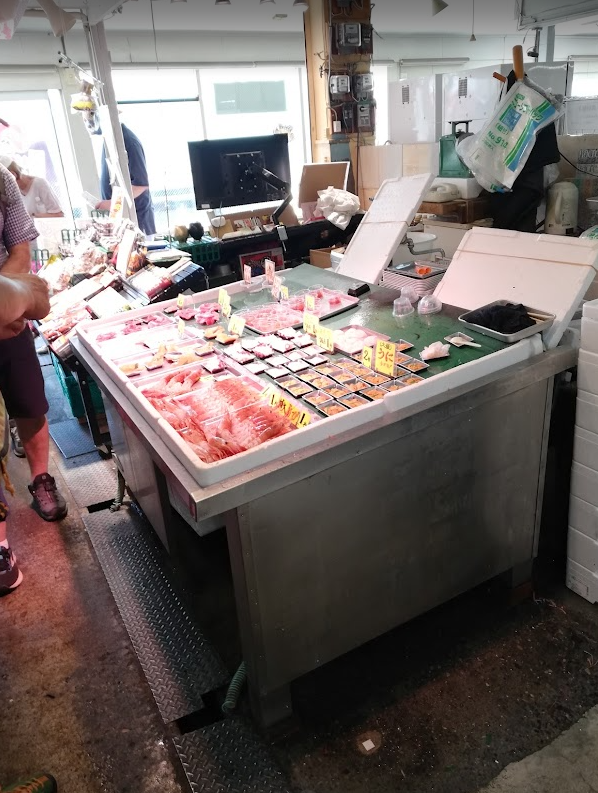
This is also thick
Look at this thickness
The joy of looking and choosing
“I’ll buy you some delicious Aomori-grown hay as a souvenir at the station”
A moment when I truly felt the owner’s kindness.
After finishing our meal, we headed to the Aomori Prefectural Tourism and Product Center “ASPAM”. The 76-meter-tall triangular pyramid building was constructed in 1986 as a landmark of Aomori. This unique shape is said to be inspired by the letter “A” of Aomori.
Going up to the observation deck on the 14th floor, we could see a panoramic view of Aomori city. Blessed with a clear day, we could even see the mountains of Hokkaido across the Tsugaru Strait.
“That’s Hokkaido! Hokkaido as seen from the northernmost tip of Honshu!”
I understand the owner’s excitement, but for me, the Aomori city visible below was more interesting. The neatly laid-out grid-like street layout tells the story of Aomori’s history as a castle town.
On the first floor, the souvenir shop is packed with Aomori’s specialty products. Apple-related goods are abundant, of course, but also garlic, scallops, Tsugaru lacquerware, and more—a condensed collection of Aomori’s charms.
“Just looking at all this makes me feel like I’ve fully experienced Aomori,” said my husband.
Next, we headed to “A-FACTORY,” just a one-minute walk from Aomori Station. Opened in 2010, this facility is a complex themed around Aomori apples and is also famous as a cider brewery.
Upon entering, the sweet aroma of apples filled the air. The cafe offers apple cider and apple-based sweets. My husband ordered an apple cider and exclaimed, “This is the fizzy taste of Aomori!” with satisfaction.
At the workshop, you can actually experience making jam, but due to time constraints, we only got to observe. Even so, just watching the artisans at work was enjoyable.
“Moo moo, Aomori accounts for about 60% of Japan’s apple production. The well-drained soil of the Tsugaru Plain and the significant temperature difference between day and night are ideal for apple cultivation.”
From the building’s deck, we had a panoramic view of Aomori Bay. It was only around 2 PM, so we had plenty of time before our 4 PM Shinkansen train.
“We can see the sea, but I don’t see any marine life,” my husband said, peering through his binoculars.
“Of course not. This is a port area, so wild whales aren’t swimming around.”
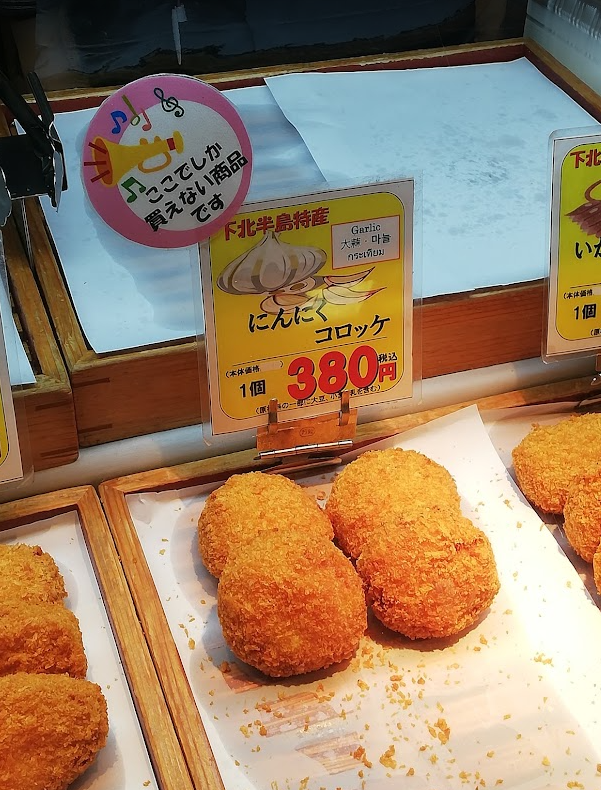
We returned to Aomori Station for souvenir shopping. We found “Aomori’s famous garlic croquettes” inside the station.
“This is Aomori’s B-grade gourmet food!” my husband exclaimed, excitedly purchasing them.
After taking a bite, I thought, “Hmm, the flesh is dry…” Indeed, even just looking at it, the flesh was crumbling. Perhaps my expectations were too high.
Garlic Croquette
“Yeah, I guess not everything being delicious is part of the charm of traveling.”
Souvenir Time – Bringing Home the Flavors of Tsugaru
I was careful in choosing souvenirs. I bought Aomori apple cider and instant ramen from “Nagao,” a Tsugaru dried sardine ramen shop.
“Nagao ramen is Aomori’s soul food, you know.”
Nagao ramen is a long-established shop founded in 1951, characterized by its clear soup made with dried sardines from the Tsugaru region. It’s said that even the instant version offers an authentic taste.
The Return Journey – The Sense of Accomplishment from a Day Trip to Aomori
We headed to Tokyo Station on the Shinkansen around 4 PM. We said goodbye to the Aomori scenery visible from the train window.
“Moo moo, it was just a day trip to Aomori, but I surprisingly enjoyed it.”
I was once again impressed by my husband’s energy. It was a grueling trip, leaving Tokyo at 9:30 in the morning and returning home that evening, but it was a fulfilling day, with a seafood bowl at the Aomori Fish and Vegetable Center, a spectacular view from ASPAM, and an apple-related experience at A-FACTORY.
I believe that travel isn’t about distance or length of time, but about feeling the atmosphere of the place and experiencing its culture. Even on a day trip, we were able to fully enjoy the bounty of Aomori’s sea, the sweet scent of apples, and the warmth of the people of Tsugaru.
It might sound strange coming from a cow like me, but humans are truly greedy creatures. They seek to have the maximum experience within a limited time and strive to achieve it. Watching my husband like that makes me think that sometimes seemingly reckless challenges are what enrich life.
Only 5 prefectures left to conquer the whole country. I’m looking forward to seeing where we’ll go next.
投稿者プロフィール



 にほんブログ村